


9/03/2010
What the Lord is Doing in Lomie
Fifty Proclaimers with the Nzime New Testament have gone out to Lomie. Francois Medjo will deliver them and create new listening groups in response to the guidance of the Christian leaders in the area. Roman Catholic priests and Protestant pastors alike are looking at this tool as a major means of breaking through to the soul of the Nzime people with the Good News ("Gospel" in old English) of Jesus Christ. Pray for many miles of safe driving for Francois on his motorcycle.


8/30/2010
Break-in in the Lomie Office
On August 25 a group of young men were seen around 3 AM near the office of Francois Medjo in Lomie. Shortly thereafter, a door and a window were broken to permit access. Thieves smashed three chairs and tore up papers in a senseless way. They stole 2 reams of paper, 3 laptops, 2 cell phones and a digital camera. They also took 20 New Testaments in Nzime and 10 literacy books. They left behind a laser printer. Later they brought back a laptop that was protected by a password.
We are not sure why they wanted the New Testaments, but it is one of the interesting aspects of the break-in. God watches over His Word and sends it to do His will.
“For as the rain and the snow come down from heaven
and do not return there but water the earth, making it bring forth and sprout, giving seed to the sower and bread to the eater, so shall my word be that goes out from my mouth; it shall not return to me empty,
but it shall accomplish that which I purpose,
and shall succeed in the thing for which I sent it.” Isaiah 55:10-11
Praise the Lord that one of these thieves has been apprehended. Pray for Francois Medjo as he seeks to retrieve the stolen items and restore peace, order and security to the office.
************************U P D A T E************************
Francois Medjo received word that the leader of the gang was captured. He went to the departmental capital (Abong Mbang) and to the regional capital (Bertoua) to deal with the authorities and the gendarmes. They are now returning to Lomie with the gang-leader in restraints. The gendarmes hope to "roll up" the entire gang and restore order in Lomie.
We are not sure why they wanted the New Testaments, but it is one of the interesting aspects of the break-in. God watches over His Word and sends it to do His will.
“For as the rain and the snow come down from heaven
and do not return there but water the earth, making it bring forth and sprout, giving seed to the sower and bread to the eater, so shall my word be that goes out from my mouth; it shall not return to me empty,
but it shall accomplish that which I purpose,
and shall succeed in the thing for which I sent it.” Isaiah 55:10-11
Praise the Lord that one of these thieves has been apprehended. Pray for Francois Medjo as he seeks to retrieve the stolen items and restore peace, order and security to the office.
************************U P D A T E************************
Francois Medjo received word that the leader of the gang was captured. He went to the departmental capital (Abong Mbang) and to the regional capital (Bertoua) to deal with the authorities and the gendarmes. They are now returning to Lomie with the gang-leader in restraints. The gendarmes hope to "roll up" the entire gang and restore order in Lomie.
8/25/2010
Imported words for the Bible
There is a constant need to modernize living languages, and Badwe'e is a good case in point. The speakers of Badwe'e feel at ease in adding borrowed words if they contribute to the communication task.
One example that was new to me concerns the word "Mpa'ra". It had two meanings originally: "association" and "pair". (Note: This word is a derivation from the verb "ba'ra", which means "join; add to") The second meaning has now lost acceptance and is being expressed by a borrowed word, "pia", which comes from "pair [English]" or "paire[French]".
The Nzime are not so quick to incorporate words from European languages. Instead, they sometimes borrow from other Bantu languages.
Their word for "pair" is "mpa' ", which is distinct from all other words. Their word for "association" is either "mpa'ra" or "kwan", which is borrowed from a neighboring African language, Ewondo.
One example that was new to me concerns the word "Mpa'ra". It had two meanings originally: "association" and "pair". (Note: This word is a derivation from the verb "ba'ra", which means "join; add to") The second meaning has now lost acceptance and is being expressed by a borrowed word, "pia", which comes from "pair [English]" or "paire[French]".
The Nzime are not so quick to incorporate words from European languages. Instead, they sometimes borrow from other Bantu languages.
Their word for "pair" is "mpa' ", which is distinct from all other words. Their word for "association" is either "mpa'ra" or "kwan", which is borrowed from a neighboring African language, Ewondo.
8/24/2010
The Nzime Language Academy

Anzyom Brigitte (shown second from the right) is the president of the "Nzime Academy" that is working on keeping their language from becoming relegated to a future as limited as its past, one in which there is an inability to write or read and so to impact their environment and future generations. In the past, minute-taking and reporting on meetings would only be in French ("pulasi"). Now, however, their confidence as writers and pride in their language has lead them to write their minutes in Nzime.
The following is a part of the minutes that they took in Nzime:
"Anziom Brigitte a nʉa lwib lɨ egʉa paʼla bʉr sa bɨh bé sa mya pihe yɨ. Syɛɛla yaa, yé a si mvol buobuo bʉr lɨ egʉa mpʉ gwɨhla Academie di etye, ndu e sa yé di epʉgʉ gwɨm esa yɨ. Tɨ', yé si nyin ó, Academie, yé ó gwɨhla di egwɨm mepwaʼ me kul bʉr o nzime. Yé lɨ esaa menzɨ me di ó, bʉr o nzime bé pɔʼa lɨ egʉʼla ndu e l'ekamle e lwib nzime. Academie, yé lɨ esaa menzɨ di ó, lwib nzime, yé bwaʼaa ndu e l'etiʼe mpʉ lwib pulasi ndu e lwib ngɨlis. Ebe no ó, bʉr o bʉm yaa di esaa mekan medwan di edumo le bisa bidwan di epyal tʉŋlʉ bitwiʼ ndu e metum me nzime lɨ esu e mepwaʼ me bʉr o nzime yɨ."
One of their concerns is to develop the Nzime language as a more adequate language for expressing new ideas of importance to the life and changing customs of the Nzime people. As they desire greater progress and development, they look to ways of making their language a resource. In the above text, they use the word " mepwa' " to express "progress/development". This is a nominalization of the verb " bwa' "meaning "to be big."
8/08/2010
The Swo People on the path to a new future
There is a new blog on the internet entitled "Nouvelles du peuple Swo". The point of this website is to enable speakers of Swo to exchange information and documents in and about their language and culture.
The Swo people have two dialects, and in one dialect the language is pronounced "So".
At the present moment, it is the Reverend Simon Pierre Ossimba who serves the Swo people in the role of website manager.
He says that it is important that the Swo people become confident users of their language in all manners, including writing and reading.
In addition to being a pastor in the Presbyterian Church (EPC), Rev. Ossimba works in the Ministry of Basic Education.
The Swo people have two dialects, and in one dialect the language is pronounced "So".
At the present moment, it is the Reverend Simon Pierre Ossimba who serves the Swo people in the role of website manager.
He says that it is important that the Swo people become confident users of their language in all manners, including writing and reading.
In addition to being a pastor in the Presbyterian Church (EPC), Rev. Ossimba works in the Ministry of Basic Education.
7/24/2010
Nzime Catechism Going Forward
A Presbyterian pastor, Rev. Ernest N., Said that he finds the catechism a valuable resource for his preaching. He has been using its questions and answers to help his congregation in Messok master the important concepts of the Christian faith. These are supporting the biblical texts that are the basis of true doctrine.
He wants a printing of 200 catechisms to be done by early next month. We are trusting God to make this possible. The plan he has is that two of them would be placed in every chapel throughout the district ("consistoire" in French). We are praying for this to take place in an God-honoring manner.
I have taken the 64-page booklet to a printshop here in Yaounde and they hope to have it ready in 1 to 2 weeks. I asked them to try for 1 week, so we could get it out to the Presbyterians meeting in Zoadiba for their annual leadership training session, Aug. 18-22.
Another important rendez-vous is Sept. 13-26, when lay preachers will be meeting in Zoulabot 1, a town on the eastern border of the Nzime region, on the way to Yokadouma. The lay preachers should find this tool very helpful as they meet with those seeking to know the truth in God's Word.
He wants a printing of 200 catechisms to be done by early next month. We are trusting God to make this possible. The plan he has is that two of them would be placed in every chapel throughout the district ("consistoire" in French). We are praying for this to take place in an God-honoring manner.
I have taken the 64-page booklet to a printshop here in Yaounde and they hope to have it ready in 1 to 2 weeks. I asked them to try for 1 week, so we could get it out to the Presbyterians meeting in Zoadiba for their annual leadership training session, Aug. 18-22.
Another important rendez-vous is Sept. 13-26, when lay preachers will be meeting in Zoulabot 1, a town on the eastern border of the Nzime region, on the way to Yokadouma. The lay preachers should find this tool very helpful as they meet with those seeking to know the truth in God's Word.
7/23/2010
New insights into the Swo phonology
A consonant is sometimes followed by a fricative in Swo. For example, some words are "b" followed by a vowel and others are "bv" in that same position.
What is growing clear is that the affricates (bv, pf, kf, dv, etc.) are all followed by a "high" vowel, /u/. I am going to be looking to see if the affricates are also found before the equally high vowels /i/ and /ɨ/. The barred "i" is high, central, unrounded.
So far, this looks very similar to what is happening in Badwe'e and in Nzime. In those languages, there is "oral cavity friction" accompanying a consonant when the following vowel is [+high].
These are subphonemic alterations in the pronunciation of a consonant.
If the Swo language truly has predictable affricatization before high vowels, the presence of the affricate would not be need to be marked.
The data would suggest this to be true. On Aug. 6, Pastor Ossimba and I observed that the affricate "ts" in [tsɨrɨ], "meat, animal", is indeed coming before a high vowel, /ɨ/, [high, central, unrounded]. It obeys the rule, therefore, that a stop becomes affricated before a high vowel, such as /i/, /ɨ/ or /u/.
What is growing clear is that the affricates (bv, pf, kf, dv, etc.) are all followed by a "high" vowel, /u/. I am going to be looking to see if the affricates are also found before the equally high vowels /i/ and /ɨ/. The barred "i" is high, central, unrounded.
So far, this looks very similar to what is happening in Badwe'e and in Nzime. In those languages, there is "oral cavity friction" accompanying a consonant when the following vowel is [+high].
These are subphonemic alterations in the pronunciation of a consonant.
If the Swo language truly has predictable affricatization before high vowels, the presence of the affricate would not be need to be marked.
The data would suggest this to be true. On Aug. 6, Pastor Ossimba and I observed that the affricate "ts" in [tsɨrɨ], "meat, animal", is indeed coming before a high vowel, /ɨ/, [high, central, unrounded]. It obeys the rule, therefore, that a stop becomes affricated before a high vowel, such as /i/, /ɨ/ or /u/.
7/22/2010
So Phonology Underway
The So people are showing evidence of considerable interest in their language and are reporting that more and more people are asking how they can be involved in determining their own future. They want a future in which they can write to each other and even to future generations.
They can do this only if they have a written language.
Pastor Simon Pierre OSSIMBA and I worked this afternoon on the phonological description of their language. I began by giving him a brief lecture on phones, phonemes and graphemes.
The concern we first addressed is to understand their inventory of vowels. We are in the process of collecting words that can reflect to us how many letters are in the inventory of phonemes.
So far, we are making good progress and seem to have tentatively identified the following vowel system: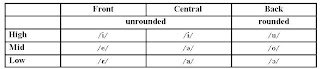
They can do this only if they have a written language.
Pastor Simon Pierre OSSIMBA and I worked this afternoon on the phonological description of their language. I began by giving him a brief lecture on phones, phonemes and graphemes.
The concern we first addressed is to understand their inventory of vowels. We are in the process of collecting words that can reflect to us how many letters are in the inventory of phonemes.
So far, we are making good progress and seem to have tentatively identified the following vowel system:

Genesis being brought to completion
Genesis is an exciting and troubling book to translate into Badwe'e. Our team is struggling and finding their efforts rewarded by success. Our part in this is the exegetical check and the pre-publication check. We are hoping to get another consultant check in August.
This is likely to be a spot-check.
Part of the pre-publication spot check involves doing a "free" translation of the Badwe'e text into French.
After that, the next part is a "parse" of each word into its components. Words are dissected and prefixes, roots and suffixes are displayed in such a way that the computer "understands" them.
This is bearing fruit in another way: the dictionary is being built up.
This is likely to be a spot-check.
Part of the pre-publication spot check involves doing a "free" translation of the Badwe'e text into French.
After that, the next part is a "parse" of each word into its components. Words are dissected and prefixes, roots and suffixes are displayed in such a way that the computer "understands" them.
This is bearing fruit in another way: the dictionary is being built up.
Subscribe to:
Posts (Atom)