


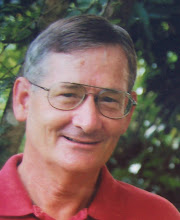
A Presbyterian pastor, Rev. Ernest N., Said that he finds the catechism a valuable resource for his preaching. He has been using its questions and answers to help his congregation in Messok master the important concepts of the Christian faith. These are supporting the biblical texts that are the basis of true doctrine.
He wants a printing of 200 catechisms to be done by early next month. We are trusting God to make this possible. The plan he has is that two of them would be placed in every chapel throughout the district ("consistoire" in French). We are praying for this to take place in an God-honoring manner.
I have taken the 64-page booklet to a printshop here in Yaounde and they hope to have it ready in 1 to 2 weeks. I asked them to try for 1 week, so we could get it out to the Presbyterians meeting in Zoadiba for their annual leadership training session, Aug. 18-22.
Another important rendez-vous is Sept. 13-26, when lay preachers will be meeting in Zoulabot 1, a town on the eastern border of the Nzime region, on the way to Yokadouma. The lay preachers should find this tool very helpful as they meet with those seeking to know the truth in God's Word.
7/24/2010


7/23/2010
New insights into the Swo phonology
A consonant is sometimes followed by a fricative in Swo. For example, some words are "b" followed by a vowel and others are "bv" in that same position.
What is growing clear is that the affricates (bv, pf, kf, dv, etc.) are all followed by a "high" vowel, /u/. I am going to be looking to see if the affricates are also found before the equally high vowels /i/ and /ɨ/. The barred "i" is high, central, unrounded.
So far, this looks very similar to what is happening in Badwe'e and in Nzime. In those languages, there is "oral cavity friction" accompanying a consonant when the following vowel is [+high].
These are subphonemic alterations in the pronunciation of a consonant.
If the Swo language truly has predictable affricatization before high vowels, the presence of the affricate would not be need to be marked.
The data would suggest this to be true. On Aug. 6, Pastor Ossimba and I observed that the affricate "ts" in [tsɨrɨ], "meat, animal", is indeed coming before a high vowel, /ɨ/, [high, central, unrounded]. It obeys the rule, therefore, that a stop becomes affricated before a high vowel, such as /i/, /ɨ/ or /u/.
What is growing clear is that the affricates (bv, pf, kf, dv, etc.) are all followed by a "high" vowel, /u/. I am going to be looking to see if the affricates are also found before the equally high vowels /i/ and /ɨ/. The barred "i" is high, central, unrounded.
So far, this looks very similar to what is happening in Badwe'e and in Nzime. In those languages, there is "oral cavity friction" accompanying a consonant when the following vowel is [+high].
These are subphonemic alterations in the pronunciation of a consonant.
If the Swo language truly has predictable affricatization before high vowels, the presence of the affricate would not be need to be marked.
The data would suggest this to be true. On Aug. 6, Pastor Ossimba and I observed that the affricate "ts" in [tsɨrɨ], "meat, animal", is indeed coming before a high vowel, /ɨ/, [high, central, unrounded]. It obeys the rule, therefore, that a stop becomes affricated before a high vowel, such as /i/, /ɨ/ or /u/.
7/22/2010
So Phonology Underway
The So people are showing evidence of considerable interest in their language and are reporting that more and more people are asking how they can be involved in determining their own future. They want a future in which they can write to each other and even to future generations.
They can do this only if they have a written language.
Pastor Simon Pierre OSSIMBA and I worked this afternoon on the phonological description of their language. I began by giving him a brief lecture on phones, phonemes and graphemes.
The concern we first addressed is to understand their inventory of vowels. We are in the process of collecting words that can reflect to us how many letters are in the inventory of phonemes.
So far, we are making good progress and seem to have tentatively identified the following vowel system: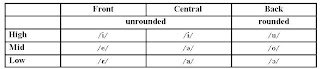
They can do this only if they have a written language.
Pastor Simon Pierre OSSIMBA and I worked this afternoon on the phonological description of their language. I began by giving him a brief lecture on phones, phonemes and graphemes.
The concern we first addressed is to understand their inventory of vowels. We are in the process of collecting words that can reflect to us how many letters are in the inventory of phonemes.
So far, we are making good progress and seem to have tentatively identified the following vowel system:

Genesis being brought to completion
Genesis is an exciting and troubling book to translate into Badwe'e. Our team is struggling and finding their efforts rewarded by success. Our part in this is the exegetical check and the pre-publication check. We are hoping to get another consultant check in August.
This is likely to be a spot-check.
Part of the pre-publication spot check involves doing a "free" translation of the Badwe'e text into French.
After that, the next part is a "parse" of each word into its components. Words are dissected and prefixes, roots and suffixes are displayed in such a way that the computer "understands" them.
This is bearing fruit in another way: the dictionary is being built up.
This is likely to be a spot-check.
Part of the pre-publication spot check involves doing a "free" translation of the Badwe'e text into French.
After that, the next part is a "parse" of each word into its components. Words are dissected and prefixes, roots and suffixes are displayed in such a way that the computer "understands" them.
This is bearing fruit in another way: the dictionary is being built up.
6/07/2010
Dictionary development in Badwe'e
The process of language development includes dictionary-making. We have not helped the Badwe'e people do their dictionary yet, so we are preparing one for them to add to and improve.
It is over 3000 words in length.
We are confident of the completeness of only one part of the dictionary, the adjectives. This is because the adjectives of Bantu languages are usually a "closed set". Otherwise stated, they are few in number. The other words used do qualify a noun are nouns.
The 12 adjectives in Badwe'e have the following meanings:
"light" and "dark"
"small" and "big"
"same" and "different"
"new" and "old-fashioned"
"cold" and "hot"
"genuine"
"complete"
I hope that the rest of the dictionary can become somewhat more complete now.
It is over 3000 words in length.
We are confident of the completeness of only one part of the dictionary, the adjectives. This is because the adjectives of Bantu languages are usually a "closed set". Otherwise stated, they are few in number. The other words used do qualify a noun are nouns.
The 12 adjectives in Badwe'e have the following meanings:
"light" and "dark"
"small" and "big"
"same" and "different"
"new" and "old-fashioned"
"cold" and "hot"
"genuine"
"complete"
I hope that the rest of the dictionary can become somewhat more complete now.
6/02/2010
"Genesis" in Badwe'e is now being checked
Mary and I are comparing the Badwe'e translation of Genesis with the Hebrew text and finding many ways to assist the Badwe'e translation team in improving it. One of our advantages is knowing about those "literary devices" that were used by the human author of Genesis to lend prominence to the part of the text that was deemed most important.
Another important literary device is backgrounding. It may be hard to recognize for someone unable to read the Hebrew.
Fortunately, our main Badwe'e translator is now going to seminary and is learning Hebrew.
We expect that the benefits from this will be a more exact translation, which also maintains its high standard of clarily and naturalness.
Another important literary device is backgrounding. It may be hard to recognize for someone unable to read the Hebrew.
Fortunately, our main Badwe'e translator is now going to seminary and is learning Hebrew.
We expect that the benefits from this will be a more exact translation, which also maintains its high standard of clarily and naturalness.
5/04/2010
Community Mobilization
The So community has completed a period of reflection about the need of a written form of their language and of a translation of God's Word. They have sent some members of their community to a program which was held by SIL and by CABTAL at the SIL training center. Please pray that they will return from it with a new understanding about how a whole community can be involved in the Bible Translation task.
Janvier Ekoalea Succeeding in Seminary
Janvier Ekoalea is praising the Lord for a largely successful conclusion to the first year at seminary. Keith and he have had conversations about the meaning of the Hebrew and Greek texts. We are grateful for the instruction that he is receiving and see this as a very promising new development in the Lord's work.
New Literacy Campaign
Keith and Mary helped the Badwe'e and Nzime language communities complete new literacy manuals in the first quarter. Pray for new interest in becoming literate with a simplified writing system.
Subscribe to:
Posts (Atom)