


Showing posts with label Nzime. Show all posts
Showing posts with label Nzime. Show all posts
10/14/2010
Building a dictionary and parser in Nzime
A long-term goal is building a dictionary in Nzime. This is indirectly useful for the creation of a spelling-checker that can be used with Open Office. As I work through the dictionary, questions arise about the translation of Genesis in Nzime. I send these questions to Francois Medjo who is building a Nzime committee to work on the fine-tuning of Genesis, including the language academy.


9/28/2010
Reading through Genesis in Nzime
Praise the Lord! The two leaders of the Nzime church we hoped to work with are now in Yaounde and we have finished 3 Days of reading and processing GENESIS! We have read and revised chapters 1-43, making lots of decisions about to say about some matters that are new to us, which do not occur in the New Testament (©The Bible League, 1998). I have finished the adaptation of the (checked) text of Genesis from Badwe'e to Nzime. The complete document will now be sent to the translation review committee when ready for them to read and check. These two church-leaders just said that what they need most next are the Psalms, and they want them ALL!
9/18/2010
What Happens Next? The Adaptation of Genesis
We have helped the Badwe'e translators complete and test a translation of Genesis, and on Sept 20 it was finally checked and approved for publication. The exegetical consultant for this task was Patricia Wilkendorf, who says she never has enjoyed a checking assignment so much. The text will next be adapted into Nzime, where the Christian community is eagerly awaiting it. The interchurch committee has picked two community leaders for this task: Rev. Ernest Njyelo, a Presbyterian pastor, and Jean-Marie Koonzo', a lay leader in the Roman Catholic Church. Keith will support the adaptation process. Pray for us that this process of adaptation which will produce a first draft will go smoothly. The dates for this work are Sept. 28 to Oct. 2. It will be at the SIL center in Yaounde. We are using Adapt It, a program developed and supported by SIL. It is in use world-wide, and it has proven its worth many places, assisting bilinguals to produce first-drafts of a high quality from documents in related languages. Badwe'e is related to Nzime, and this makes Nzime a good candidate for receiving an adapted form of Genesis. When Genesis is adapted into Nzime, the texts in Nzime and Badwe'e will then be published at our expense and distributed among these two people-groups at a small fraction of the true cost. (They are economically very disadvantaged.)
"Lamentably, regrettably or unfortunately"
If you have to convey to people the sorrow and disappointment underlying a situation, you must use the lexical resources that are language-appropriate.
In Hebrew, it would seem that the pathos ("sadness") of a situation was represented by repetition of the regrettable proposition that is being narrated. This is found at two places in the text of Genesis.
Gen. 11:30 Now Sarai was barren; she had no child. (English Standard Version)
Gen. 40:23 Yet the chief cupbearer did not remember Joseph, but forgot him. (English Standard Version)
Parallelism is the distinguishing feature of Hebrew poetry, but is also found in narrative discourse, as shown above.
Given our sense that this structure is intended to convey to the Hebrew reader the pathos of the two situations, we look for the comparable expressions in Badwe'e and in Nzime. It turns out that the Nzime have a word, Nzamedwɛha, that lexicalizes the expression "regrettably; unfortunately" whereas the Badwe'e, a closely-related language, have a phrase (A vwa' e) that has the same effect. It can be translated "how lamentable with (or 'for')". They come across very differently when seen side-by-side!
In Hebrew, it would seem that the pathos ("sadness") of a situation was represented by repetition of the regrettable proposition that is being narrated. This is found at two places in the text of Genesis.
Gen. 11:30 Now Sarai was barren; she had no child. (English Standard Version)
Gen. 40:23 Yet the chief cupbearer did not remember Joseph, but forgot him. (English Standard Version)
Parallelism is the distinguishing feature of Hebrew poetry, but is also found in narrative discourse, as shown above.
Given our sense that this structure is intended to convey to the Hebrew reader the pathos of the two situations, we look for the comparable expressions in Badwe'e and in Nzime. It turns out that the Nzime have a word, Nzamedwɛha, that lexicalizes the expression "regrettably; unfortunately" whereas the Badwe'e, a closely-related language, have a phrase (A vwa' e) that has the same effect. It can be translated "how lamentable with (or 'for')". They come across very differently when seen side-by-side!
8/14/2009
Genesis being translated in Nzime
Francois MEDJO, the promoter of Scriptures in the Nzime area, has sent me the first eight chapters of Genesis to revise and comment on. These are in the Nzime dialect and represent the work of laymen and pastors. He sent them by attaching them to emails.
We are very grateful that the work of Bible translation can go forward through the wonders of the Internet.
The way we interact is by using the "tracking changes" feature of Word.
We are grateful to Microsoft for its contribution to this life-transforming task.
We are very grateful that the work of Bible translation can go forward through the wonders of the Internet.
The way we interact is by using the "tracking changes" feature of Word.
We are grateful to Microsoft for its contribution to this life-transforming task.
7/28/2009
Njyem Hearing God's Word... in Nzime(!)
The Nzime received the New Testament in 1998 as a result of the support of CABTAL and other funders. Then they received generous support from Faith Comes By Hearing, which orchestrated the recording of their New Testament and the distribution of "Proclaimers", digital players that are powered by the sun. They saw the Nzime at first responding little to the printed New Testament, but then responding with joy and excitement at the arrival of the Proclaimers. They gather together in listening groups and let the translated and recorded Word of God pour into their ears and hearts. Lives are changed, relationships restored, and people given new hope. One of the readers, Bolakam Severin, died recently in total peace, asking for nothing but the Proclaimer that he could play at all times.
ASTRADHE is the literacy and Scripture-Impact organization that is providing the supervision for this far-flung program.
The Njyem, meanwhile, were seeing little progress on their side of the river. Life was not bad, but it wasn't quite what it should be, either. They asked for a New Testament to be translated, but the resources were not forthcoming. They waited some more and then they did something uncharacteristic... they asked and asked again for the Proclaimers to be brought south across the river for use in their villages. They knew that this was going to mean that the Nzime language would gain more of a foothold in their midst, but they could not let that distasteful aspect come between them and their deeper exposure to the Word of God.
After all, the proverb says "a drowning man will even grab a snake that is swimming by if will help him to survive".
They still want the word of God in their language, but until that happens, they know they need the Proclaimer and the Nzime language that it brings.
The Presbyterian pastor of Ngoyla is Reverend Bengene Mebere Innocent. He wrote:
"We ask you to esctend the praiseworthy project into our sector, that of the Njyem. This program you initiated faacilitates the evangelization of a people group through the hearing of the Word of God in the local language.
"We have met in August 2008 in Ngoyla to study how to better evangelize this area and it was found that the main handicap was that the majority of the population was illiterate, and for this reason very few read the Bible.
"Having heard a member of ASTRADHE speak of the FCBH program, we expressed our appreciation for the program and are asking that in the days to come seven listening centers should be opened as a preliminary step. ...I will supervise the listening centers so that peoplle are blessed by the Word of God."
In the days to come, however, the Roman Catholic curé based in Ngoyla also said that he would supervise listening centers for his own parishioners. As a result, twenty listening centers have been started in the Njyem area, half under the supervision of each of the major Christian communions.
Recently, Rufine Adjowa returned from her Njyem village and said that the Proclaimer is used in church where the reading of the Word of God is called for. She said lives are being touched by God and they are finding a sure basis for their faith in God.
ASTRADHE is the literacy and Scripture-Impact organization that is providing the supervision for this far-flung program.
The Njyem, meanwhile, were seeing little progress on their side of the river. Life was not bad, but it wasn't quite what it should be, either. They asked for a New Testament to be translated, but the resources were not forthcoming. They waited some more and then they did something uncharacteristic... they asked and asked again for the Proclaimers to be brought south across the river for use in their villages. They knew that this was going to mean that the Nzime language would gain more of a foothold in their midst, but they could not let that distasteful aspect come between them and their deeper exposure to the Word of God.
After all, the proverb says "a drowning man will even grab a snake that is swimming by if will help him to survive".
They still want the word of God in their language, but until that happens, they know they need the Proclaimer and the Nzime language that it brings.
The Presbyterian pastor of Ngoyla is Reverend Bengene Mebere Innocent. He wrote:
"We ask you to esctend the praiseworthy project into our sector, that of the Njyem. This program you initiated faacilitates the evangelization of a people group through the hearing of the Word of God in the local language.
"We have met in August 2008 in Ngoyla to study how to better evangelize this area and it was found that the main handicap was that the majority of the population was illiterate, and for this reason very few read the Bible.
"Having heard a member of ASTRADHE speak of the FCBH program, we expressed our appreciation for the program and are asking that in the days to come seven listening centers should be opened as a preliminary step. ...I will supervise the listening centers so that peoplle are blessed by the Word of God."
In the days to come, however, the Roman Catholic curé based in Ngoyla also said that he would supervise listening centers for his own parishioners. As a result, twenty listening centers have been started in the Njyem area, half under the supervision of each of the major Christian communions.
Recently, Rufine Adjowa returned from her Njyem village and said that the Proclaimer is used in church where the reading of the Word of God is called for. She said lives are being touched by God and they are finding a sure basis for their faith in God.
7/23/2009
Publishing goals
This past Thursday we printed 25 copies of Badwe'e GENESIS for reviewers to study. The publisher of this document is CABTAL. They are one of the many members of Wycliffe Bible Translators International.
Another publication in circulation recently is the oral version of the KANDE Story. This is distributed by means of the "Sabre" player.
Soon we will begin printing a collection of works written by new Nzime authors that Francois Medjo trained last week in Lomié. A fund internal to SIL-Cameroon Branch is extending to them the needed money for publication.
We also have funding for the Nzime transition primer, used among Nzimes literate in French. That should go to press in August.
We are still hoping to find sponsors for the following books:
Another publication in circulation recently is the oral version of the KANDE Story. This is distributed by means of the "Sabre" player.
Soon we will begin printing a collection of works written by new Nzime authors that Francois Medjo trained last week in Lomié. A fund internal to SIL-Cameroon Branch is extending to them the needed money for publication.
We also have funding for the Nzime transition primer, used among Nzimes literate in French. That should go to press in August.
We are still hoping to find sponsors for the following books:
- The Badwe'e transition primer (for Badwe'es literate in French already)
- 300 copies of the Nzime "KANDE Story", which teaches the facts of AIDS and the way communities can survive it.)
- 300 copies of the Badwe'e "KANDE Story".
7/15/2009
Orthography guides
On other websites there are some orthography guides that helps speakers of Njyem, Nzime and Badwe'e know where to put accents as he or she writes his/her language. The general rule is "no accents unless they are required by this book." So we hope that someone will find this and make use of it to become an author. The guides require that one have a reading knowledge of French. Here they are: Njyem: http://kulnjyem.blogspot.com/2009/07/aide-memoire-pour-les-ecrivains-njyem.html Badwe'e: http://codylko.blogspot.com/2009/07/guide-pour-les-ecrivains-badwee.html Nzime: http://francoismedardmedjo.blogspot.com/2009/07/guide-pour-lorthographe-nzime-allegee.html
6/20/2009
The origin of the Koonzime people

The Koonzime ("OZM" in the Ethnologue) are a group of people with a common ancestor, Nzime ("Zime" if you speak the Badwe'e dialect). He had a son, Kɔɔ, who was a polygamist. He and one wife, Ampiʼi, had three sons, named Njeme, Nzime (for the grandfat her), and Edweʼe. (click on the JPG at the left to enlarge.) These sons gave rise to the four ethnic groups known as Njeme, Nzime, Badweʼe and Njyem.
 her), and Edweʼe. (click on the JPG at the left to enlarge.) These sons gave rise to the four ethnic groups known as Njeme, Nzime, Badweʼe and Njyem.
 The Njeme, Nzime and Badweʼe speak one language, which can be called Kɔɔnzime, and which should probably have been hyphenated: Kɔɔ-nzime. This is the short form of the following phrase:
Dyɛɛ me Kɔɔ, mwan me Nzime
people of Kɔɔ child of Nzime
The three have discernable dialects and subdialects of Kɔɔnzime.
The Njeme split into two groups, one being on the northern border of the Koonzime, at Mindourou, and the other being south of the Dja River, south of Lomie. The latter group underwent a major linguistic change and they now call themselves and their language, now distinct, as “Njyem”. Their language is identified in the Ethnologue as “NJE”.
6/14/2009
Nzime literacy work well engaged
These pictures shows how younger readers and older alike are catching on to the idea of literateness. Here is one page of a book on the importance of learning to read: 


Our coworkers in Lomie have done an good job in this regard, helping the Nzime move more and more in the direction of literateness. This is under the direction of Francois MEDJO, who is a Badwe'e who has moved into the Nzime community as an other-tongue African missionary. He is teaching a group of others to revise AIDS materials, bringing them into a new, simpler writing system.
This Nzime man is proud of his newly-acquired ability to write.

This Nzime coworker, Ghislain Nka'ala, would like to become a pastor to serve his people better. He is looking for a school that has a program suited to his needs, and for people who have finances to share with him in this endeavor. 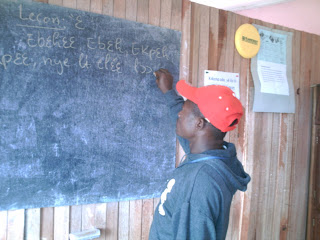

There is nothing trivial about getting a nation of people, or a people-group, started down the path of literateness, where numeracy and literacy are known about, and where they are expected to play a role in the life of all but the youngest and the blind.

Subscribe to:
Posts (Atom)