


10/25/2010
The Swo Need the Gospel
Pastor Ossimba explains why the Gospel is needed among the Swo in their language. The first reason is that they don't understand Bulu well enough and the other is that they are so poorly taught through that language that they get the wrong meaning as often as the right one. During a Christmas service, Swo children were asked to recite verses from the Bible, and one chose the passage about the baby Jesus being laid in the manger "where animals ate their food". The child, speaking in Bulu, something quite different, that he was laid in the manger "where the cattle killed and ate people." The Pastor surmised that the children probably thought that surviving the evil cattle was Christ's first miracle.


The Stolen-and-Returned Computer in for Maintenance
It is true! The Toshiba XP laptop that had been stolen and then returned is back! Unfortunately, it needs some antivirus protection and it needs to be cleaned of viruses. The hard drive sounds a bit "off", too, so maybe it needs replacing? Francois Medjo asked Brigitte, the head of the Nzime Language Academy, to drop it off. We are very grateful for God's protection of the laptop and the way the computer services department can help us. The head of the department is David Anderson. He is a valued participant in the Bible translation movement. We use Eset antivirus, which now costs as little as $8.25 per PC per year. When we send the new virus definitions out to our coworkers, they protect their computers up the the same level as ours in the capital. The laptop needed a new hard drive and a thorough cleaning out of the accumulations of dust. It is now getting ready for serious work again.
10/23/2010
Institutions for the Swo Bible Translation Movement
The Swo people have institutions such as political parties, chiefs, savings societies and such, but they will soon require two more. The reason for this is that they are engaging in two new activities: (A) translating and engaging the Word of God and (B) learning to read and write in Swo. The first activity involves all those who call themselves Christian. They need not all be speakers of Swo, since everyone can pray. The work of translating God's Word and being fed and renewed by it is the work of the Church and it must therefore be the case that an inter-church committee takes shape to execute its work under the leading of the Holy Spirit. Ecumenism is rarely seen in the absence of Bible translation. (I have read this but lost the reference.) The creation of the Swo interchurch Bible translation and Scripture-Use committee is being attended to by a Presbyterian pastor, the Reverend Simon Pierre Ossimba. Its organizational meeting should take place in the first week of November. The second activity involves all those who speak Swo and want to be able to engage with others across the printed page. Imagine not being able to hear from those of another time or place! A language committee has been in the process of being created for 3 years, but without an alphabet or orthography statement, they have been unable to proceed. Now they have at least some of these resources and will begin assuming on their roles.
10/22/2010

Becoming Literate in Swo
Swo is a well-developed language, by which I mean that its speakers find no problem in dealing with all the issues of life without recourse to other languages. It has a "mature" morphological system, both for nouns and verbs, as well as a highly complex and structured sound-system. That does not mean the speakers can write it, however. I know one speaker who has tried to write personal names in the language and gotten all tangled up in writing the phonetic form of the language rather than its phonemic form. He has not proceeded very far. Others have tried to use the writing system of Bulu. That, too, has been frustrating. In order to help show the Swo people the path forward, we have made a 1-page "alphabet chart" that shows the letters in alphabetical order on one sheet of paper. For each letter, there is a word that exemplifies the use of the letter, and an illustration of the word. Its enduring virtue will be serving as publicity for the innovation, written Swo. It also helps desensitize people to the "funny" characters. This teaches them the number and identity of the characters in their language, and their order in the Swo alphabet, but it is not otherwise pedagogically useful. For them to become literate, however, we will have to write primers for the various audiences: a primer series for complete illiterates and a slim and simpler volume those who are literate in French or in Bulu but who want to read and write Swo. This is a transition primer. We have organized its contents and will be now starting on the first lessons.
10/21/2010
Table of Contents for the Upcoming Swo Transition Primer

This is the table of contents for the transition primer that we are planning to write. It is a much smaller one than was needed for the Nzime and for the Badwe'e, owing to the smaller inventory of phonemes and graphemes. Since we are using a phonemic orthography, we spare ourselves the need of teaching the use of allophones.
For example, we teach "d" in radical initial position and use it in radical-medial position, where it has the sound of "r". Were we to use the lettre "r" in that position, we would have been obliged to teach its use in a separate lesson from the lesson on "d".
10/20/2010


10/19/2010
Swo Definite Article Following Relative Clauses
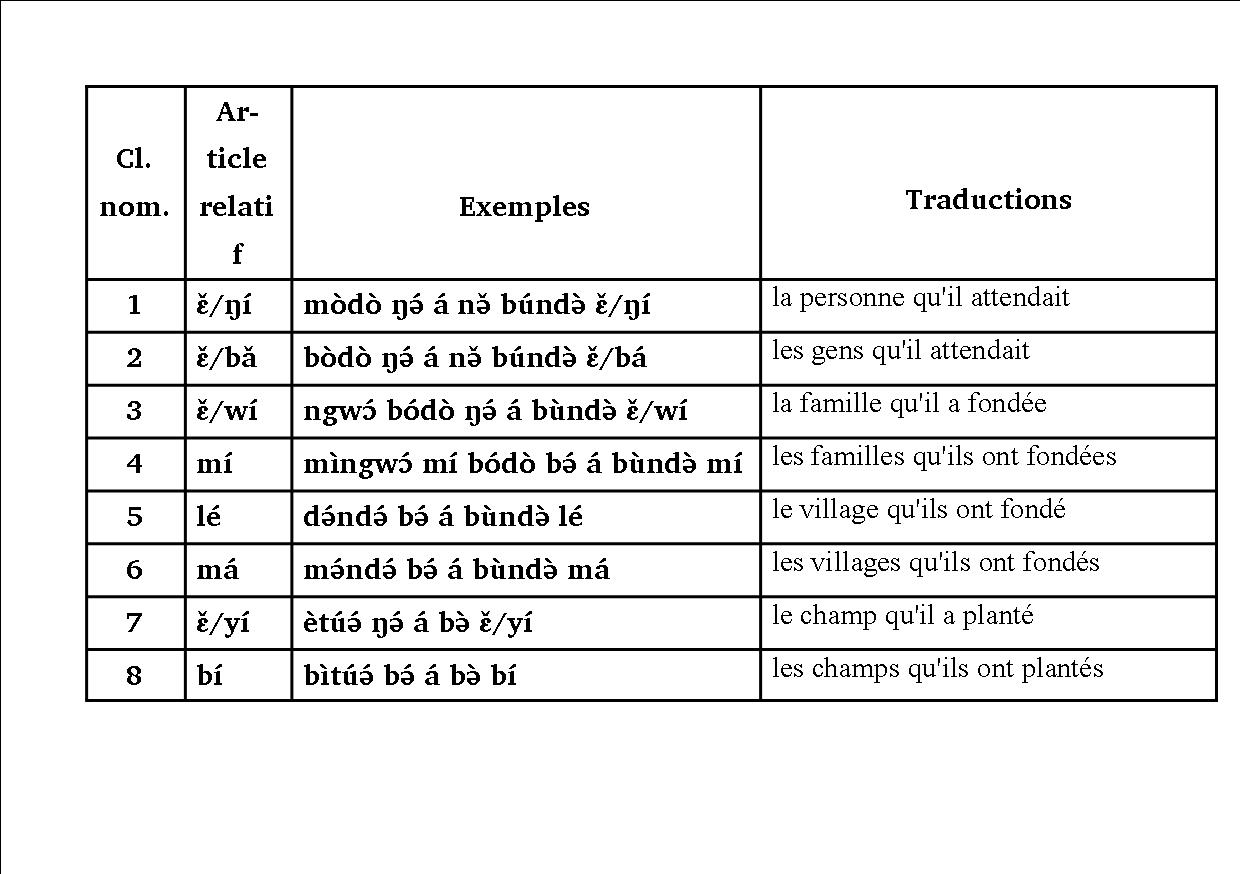
The Swo have a very understated way of identifying a nominal as being the one that has become known through talking about it: They use the word "there", (/tê/ [tɪ14]).
Example: mòdò tê, ([mʊ4rʊ4 tɪ14]) "the person there (known, definite, being talked about".
This way of identifying is the noun as definite does not indicate anything about its noun class.
If a noun is modified by a relative clause, however, the definite article that follows the relative clause does get inflected for the noun class of the noun, however. In the accompanying table, you can see the 8 noun classes followed by the "relative article", an example and a translation. For those wanting to know where the relative pronoun ("who", "that") is, it is a tone change in the first word of the relative clause. An initial low tone in that clause becomes high, showing that it is the beginning of the relative clause. A translation in French follows.
Note that there is an abbreviated form of the relative article for nouns in classes 1,2,3 and 7.
Swo Verbal Morphology
On Day Four, 10/19, Loungo Nang and I began working on the verbal morphology of Swo. One of the reasons is that if I am going to assist them in the creation of literacy materials, I simply must know the entire gamut of expression in Swo, especially how verbs are put together with tense markers, negation markers, and adverbs. We got a really good start on it!
Subscribe to:
Posts (Atom)